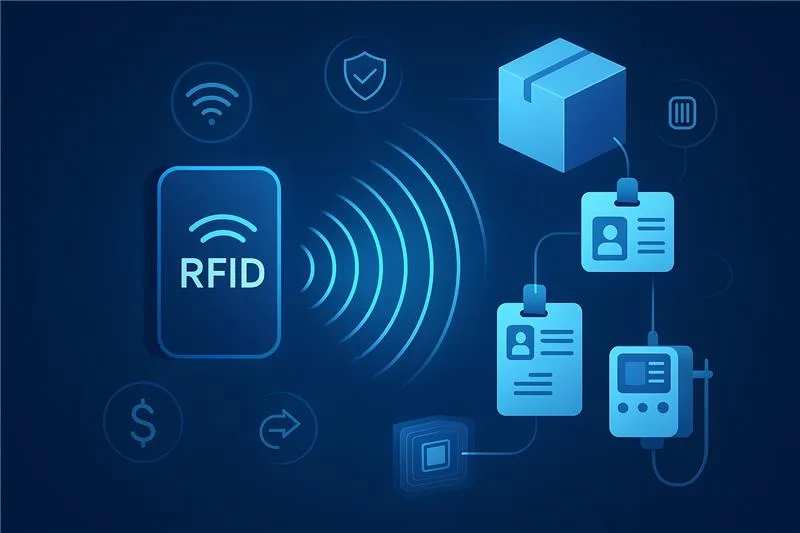
The Role of an RFID Reader
An RFID reader is a vital component of every Radio Frequency Identification system, serving as the communication bridge between RFID tags and the software that processes collected information. Unlike traditional barcode scanners that require a direct line of sight, RFID readers use radio waves to detect and retrieve data from RFID tags automatically. This capability allows organizations to identify, monitor, and manage assets quickly and accurately across various environments. RFID readers come in different forms, including handheld devices, fixed-mounted units, desktop readers, and integrated readers designed for industrial automation. Each type is developed to meet unique operational requirements while maintaining high-speed communication with tagged objects. Businesses across manufacturing, healthcare, logistics, retail, transportation, education, and government sectors increasingly rely on RFID readers to streamline workflows and eliminate manual tracking processes. Modern RFID readers can identify multiple tags simultaneously, making inventory counting significantly faster than traditional methods. They also reduce human error by automating data collection and transmitting information directly into enterprise management systems. Advanced RFID readers support different frequency ranges such as Low Frequency (LF), High Frequency (HF), and Ultra High Frequency (UHF), allowing organizations to select the appropriate technology for specific applications. Integration with cloud platforms, enterprise resource planning systems, warehouse management software, and Internet of Things networks further expands the value of RFID readers by enabling real-time visibility across operations. As industries continue embracing digital transformation, RFID readers provide a dependable solution for capturing accurate information while improving operational transparency, enhancing decision-making, and supporting long-term business growth through intelligent automation.
Key Features and Technologies Behind RFID Readers
Modern Lecteur RFID incorporate sophisticated technologies that deliver exceptional speed, reliability, and flexibility across countless applications. One of their most important features is multi-tag reading capability, allowing hundreds of RFID tags to be scanned within seconds without requiring manual positioning. This functionality dramatically improves productivity in warehouses, distribution centers, and retail environments where large quantities of products move continuously. RFID readers also offer adjustable transmission power, enabling organizations to optimize reading distances according to operational needs. Some handheld readers focus on short-range precision, while industrial fixed readers are capable of monitoring assets over much greater distances. Anti-collision technology ensures multiple RFID tags can communicate with the reader simultaneously without signal interference, maintaining consistent data accuracy during high-volume operations. Modern readers often support multiple communication interfaces including USB, Ethernet, Wi-Fi, Bluetooth, RS232, and serial connectivity, simplifying integration with existing business infrastructure. Rugged RFID readers are engineered for demanding industrial environments, featuring waterproof construction, dust resistance, shock protection, and extended operating temperature ranges. Security remains another essential characteristic, with many RFID readers supporting encrypted communication, password authentication, and secure data transmission to protect sensitive information. Advanced antenna configurations further improve reading accuracy by minimizing dead zones and maximizing signal coverage in complex facilities. Intelligent filtering algorithms help distinguish relevant RFID tags while ignoring duplicate or unnecessary reads, improving overall system efficiency. Many RFID readers now include onboard processing capabilities that reduce dependency on centralized servers, enabling faster local decision-making and edge computing applications. Combined with user-friendly configuration software and remote management capabilities, these technological advancements allow organizations to deploy RFID systems that remain scalable, adaptable, and capable of supporting evolving operational requirements well into the future.
Applications of RFID Readers Across Different Industries
RFID readers have become indispensable tools across a wide range of industries due to their ability to automate identification, tracking, and inventory management with remarkable precision. In retail environments, RFID readers enable rapid stock counting, improve inventory visibility, reduce out-of-stock situations, and support efficient omnichannel fulfillment. Warehouse operators use RFID readers to automate receiving, storage, picking, packing, and shipping processes while minimizing manual data entry errors. Manufacturing facilities rely on RFID readers to monitor raw materials, work-in-progress items, production equipment, and finished products throughout complex manufacturing workflows. Healthcare organizations utilize RFID readers to track medical equipment, pharmaceutical inventory, laboratory samples, and patient identification, improving safety while reducing misplaced assets. Transportation and logistics companies employ RFID readers to monitor cargo movement, shipping containers, delivery vehicles, and fleet operations in real time. Libraries have transformed book management by implementing RFID readers for automated check-in, check-out, inventory audits, and theft prevention. Educational institutions use RFID readers for attendance monitoring, access control, and campus security management. Government agencies deploy RFID readers for identity verification, document management, border security, and public asset tracking. Agricultural businesses benefit from RFID readers by monitoring livestock identification, equipment usage, and supply chain traceability. Hospitality organizations improve guest experiences through RFID-enabled room access, event management, and cashless payment systems. Sports venues and entertainment facilities utilize RFID readers for ticket validation, crowd management, and merchandise sales. Even construction companies employ RFID readers to monitor valuable tools, heavy machinery, and project materials across multiple job sites. These diverse applications demonstrate the flexibility of RFID reader technology in improving operational efficiency, reducing costs, increasing transparency, and delivering valuable business intelligence through accurate real-time data collection.
Benefits of Using RFID Readers for Business Operations
Implementing RFID readers offers organizations numerous operational advantages that extend beyond simple asset identification. One of the most significant benefits is increased productivity, as RFID readers automate repetitive data collection tasks that traditionally required extensive manual labor. Employees spend less time performing inventory counts, searching for misplaced assets, or recording information manually, allowing them to focus on higher-value responsibilities. RFID readers also improve inventory accuracy by providing continuous visibility into asset locations and stock levels, reducing discrepancies that often occur with manual tracking systems. Faster inventory audits enable businesses to respond quickly to changing customer demands while maintaining optimal stock availability. Enhanced traceability supports regulatory compliance by documenting product movement throughout manufacturing, storage, transportation, and distribution processes. RFID readers contribute to better security by detecting unauthorized asset movement, preventing theft, and strengthening access control systems. Real-time monitoring allows managers to identify operational bottlenecks quickly and make informed decisions using accurate data rather than estimates. Automated workflows reduce paperwork, improve reporting accuracy, and simplify internal audits through digitally recorded transaction histories. RFID readers also help lower operational costs by minimizing inventory shrinkage, reducing labor expenses, preventing equipment loss, and optimizing resource utilization. Improved customer satisfaction results from faster order fulfillment, accurate deliveries, and reliable inventory availability. In maintenance-intensive industries, RFID readers simplify equipment inspection schedules, maintenance records, and lifecycle management, extending asset longevity while reducing unexpected downtime. Environmental sustainability also benefits through reduced paper usage and optimized supply chain operations that minimize unnecessary transportation and waste. As businesses continue embracing automation and digital transformation initiatives, RFID readers provide measurable returns on investment through increased efficiency, improved accuracy, stronger security, and enhanced operational intelligence that supports sustainable long-term growth.
Future Trends Shaping the Evolution of RFID Readers
The future of RFID readers is being shaped by continuous technological innovation, increasing connectivity, and expanding demand for intelligent automation across global industries. Integration with artificial intelligence allows RFID readers to generate predictive insights by analyzing large volumes of operational data and identifying patterns that support proactive decision-making. Internet of Things ecosystems continue connecting RFID readers with sensors, machines, enterprise software, and cloud platforms, creating fully integrated digital environments capable of real-time monitoring and automated responses. Fifth-generation wireless connectivity enhances RFID reader performance by supporting faster communication speeds, lower latency, and more reliable large-scale deployments. Edge computing enables RFID readers to process information locally, reducing response times while minimizing network bandwidth requirements. Miniaturization trends are making RFID readers smaller, lighter, and more energy-efficient, expanding their suitability for mobile applications and embedded systems. Improved antenna technologies continue extending reading distances while increasing accuracy in challenging environments containing metal surfaces, liquids, or dense product arrangements. Sustainability initiatives are encouraging manufacturers to develop energy-efficient RFID readers with lower power consumption and environmentally responsible production methods. Enhanced cybersecurity features, including stronger encryption protocols and advanced authentication mechanisms, help protect increasingly connected RFID infrastructures from evolving digital threats. Machine learning algorithms further improve reading accuracy by automatically adapting to changing operational conditions and optimizing system performance over time. As smart factories, autonomous warehouses, digital healthcare, intelligent transportation, and connected cities become more widespread, RFID readers will play an increasingly central role in collecting reliable data that supports automation and informed decision-making. Organizations investing in advanced RFID reader technology today position themselves to benefit from greater efficiency, enhanced visibility, improved scalability, and stronger competitiveness in an increasingly data-driven global marketplace where accurate, real-time information has become one of the most valuable business resources.